The best app to print text messages from an iPhone for court, and the one column that decides it
For a document going in front of a court, the thing that separates these programs is not price, platform or how the interface looks. It is where the words come from and where they are turned into a document: Apple’s message database read on your own computer, or a conversation sent to a vendor’s servers to be built there. One of the five below does the second thing on the iPhone, and it says so in its own words.
Everything else here is detail. Every figure was first checked on 4 August 2026 on the vendor’s own pages or App Store listing, with the date of the latest reading repeated on each row, because a price or a capability quoted without a date is the kind of claim this comparison exists to avoid.
What does “best for court” actually mean?
It means the document survives the questions the other side asks about it, and those questions are predictable.
Where did this come from. Is this the whole conversation or the part that suits you. How do we know that name is that person. Why does this message have a time on it and that one not. Has this file been altered since it was made. What is on the page before and after the one you handed us.
A program cannot make a judge accept anything, and any product that says it can should worry you. What a program can do is make those six questions boring to answer. That is the entire brief, and it is the standard the table below is ranked against.
In the United States, one recognised route is Federal Rule of Evidence 901(b)(4), which covers “the appearance, contents, substance, internal patterns, or other distinctive characteristics of the item, taken together with all the circumstances”. Distinctive characteristics is a phrase that rewards a document carrying more of them, which is why the columns below are the columns they are. What your own court requires is a question for a lawyer, and exporting iPhone messages for court sets out what the document carries in more detail without predicting what anyone will do with it.
The five programs, on 4 August 2026
| Program | Price | Where the text comes from | Platforms | Checked |
|---|---|---|---|---|
| Decipher TextMessage | 29.99 USD, one time | Apple backup, message database | Windows, macOS | 4 Aug 2026 |
| ChatExport | free trial, then a one time licence | Apple backup, message database | Windows | 4 Aug 2026 |
| iMazing | 29.99 USD/year for one device, 49.99 for five, subscription only | Apple backup, message database | Windows, macOS | 15 Oct 2026 |
| TouchCopy | 70 USD lifetime, two PCs | Apple backup, message database | Windows, macOS | 4 Aug 2026 |
| TextPort | desktop apps free; on iPhone the first three conversations free, then from 4.99 USD/week to 59.99/year, several tiers at once | iPhone: iMessage through Apple Shortcuts, built on its servers (4 Oct 2026); Windows: an unencrypted iPhone backup on the PC; Mac: the Messages on the Mac | iOS, Windows, macOS | 15 Oct 2026 |
Why does the source column decide it?
Because the first question asked of a court document is where it came from, and that column is the answer you will have to give.
TextPort is on this list because it is the one entry that runs on the phone itself, so anyone searching from an iPhone will meet it first. Re-read in October 2026, its vendor says the iPhone app “pulls it straight out of iMessage” and “uses secure cloud processing to build the clean, timestamped export”, so on its way to becoming a document the conversation leaves your phone for the vendor’s servers. If the document is contested, that is a step you will be asked to account for. TextPort’s desktop apps are a different case, read on 15 October 2026: they are free, the Windows one reads an iPhone backup on the PC and says “your messages never leave your computer”, but “TextPort reads unencrypted backups” and walks you through turning the encryption off; the Mac one exports the Messages on the Mac.
The four programs that read the database start from the rows iOS wrote, so they carry a timestamp on every message to the second, the number beside the name, receipts where iOS recorded them, and the thread from its first message to its last regardless of what any screen displayed. One setting qualifies that last part: with Messages in iCloud switched on, Apple documents computer backups as not including messages already stored in iCloud. The check costs a minute and is the export itself: open the conversation and confirm the oldest messages you need are there.
If nobody is going to contest the conversation, this distinction does not matter and an app on the phone is a reasonable route. If somebody is going to contest it, this distinction is the whole comparison.
Which of the four should you use?
Ranked for this one purpose, with the reason stated, because a comparison whose author sells one of the entries owes you that.
Decipher TextMessage is the safe default. It is 29.99 USD once, runs on Windows and macOS, reads the backup rather than the device, opens encrypted backups, and its maker says it has been in business since 2010. That length of track record is itself worth something, and if you want the answer with the least to explain, that is the answer.
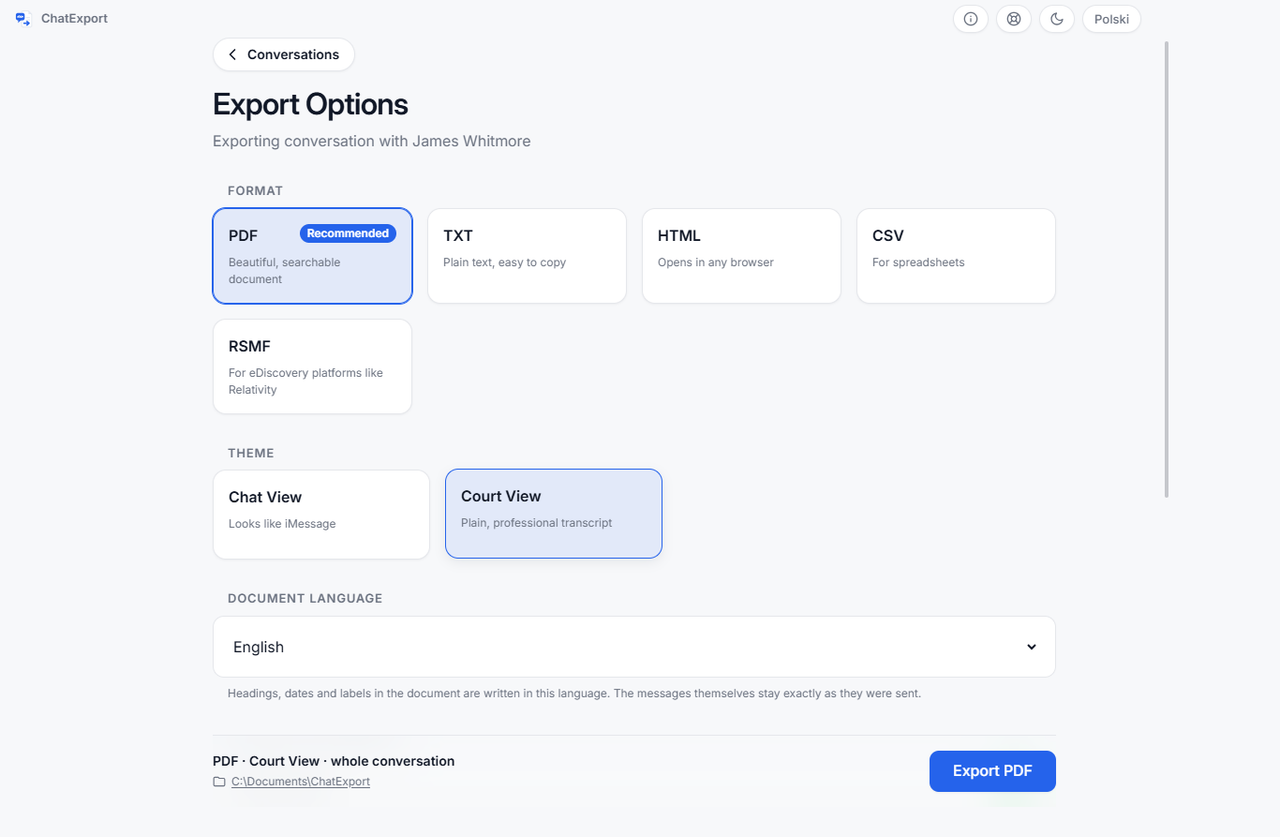
This program is the one built for the document rather than for the phone. It is placed second rather than first on purpose: it is newer, it is Windows only, and it has no track record to point at. What it has instead is a layout designed for filing rather than for reading on a sofa. Court View drops the chat bubbles, numbers every message down the margin so a line can be cited as “#412” instead of “near the bottom of page 19”, prints full timestamps to the second, and puts the raw number beside each contact name, which is a decision worth understanding before you file anything: see contact names against phone numbers in an export. An attachment index is its own switch, not part of the view. The finished file gets a SHA256 checksum, shown on screen and written beside the export, so the document can be shown later not to have changed; what that does and does not prove is set out in how to verify a PDF with SHA256 in 30 seconds. It also writes the document in any of fourteen languages, which matters if the annex has to be read by a court that does not work in English.
iMazing if you also want the phone managed, and if a yearly bill for a task you will do once does not bother you. It moved to subscription only in June 2025, which is covered in the iMazing alternative for Windows.
TouchCopy if you want the rest of the phone too, with a lifetime licence covering two computers and no auto-renewal.
TextPort if the iPhone is the only computer you have. It is the only option in that situation, and it is better than nothing. Go in knowing that the iPhone app builds the document on the vendor’s servers, not on your phone.
What can none of them do?
Promise admissibility. Recover a message deleted before the backup was made, beyond the roughly thirty day window iOS 16 and later keep recently deleted messages in. Prove who was holding the phone when a message was sent. Or tell you what your particular judge, in your particular jurisdiction, will accept.
A tool reproduces a record. Everything after that is law, and this site is not qualified to practise it.
Frequently asked questions
Do I need to print the whole conversation, or can I print part of it?
You can print a date range, and for anything contested you should think hard before doing it. Which route you print by changes what the pages carry, and the five of them are compared in how to print text messages from an iPhone. A thread with the inconvenient parts still in it is much harder to attack than a curated one, and directing a reader to a page number costs nothing. The settings that shrink a thread without you asking, including one on the phone itself, are covered in how to export an entire iMessage conversation.
Does the app need to keep the phone connected?
Only long enough to make the backup, once. All four database readers work from the backup folder afterwards. Making that backup without involving iCloud is how to back up iPhone text messages to a PC without iCloud.
Are free ways of doing this good enough?
Sometimes, and it depends far more on length than on stakes. For a short exchange, screenshots or printing from Messages on a Mac produce something usable. For a few hundred messages the cost stops being money and becomes hours, the free methods and what they cost in time does that arithmetic.
What does ChatExport cost?
The download is a free trial: it opens any backup and previews any conversation in full, then watermarks a trial export and stops after the 50 most recent messages. A one time licence lifts both and is on sale now, and there will never be a subscription. The figure is on the pricing page, in one price with no tiers to decode.
Why is there no macOS version of ChatExport?
Because a Mac signed into the same Apple ID, with message syncing on, already has the conversation in the built-in Messages app and can print from it, while a Windows user with an iPhone has no supported route at all. That is the gap this was built for. It is a real limitation and this site has said so since its first day.
Before you buy anything, look at the artifact. The sample exports are real files from this program’s own export pipeline, over an invented custody dispute, so you can open a finished Court View PDF, see the numbering, the timestamps and the checksum page, and judge it against whatever a trial of any other program hands you.