How to submit text messages as evidence in a workplace grievance
To submit text messages in a workplace grievance, export the conversation from a phone backup as a dated transcript rather than sending screenshots, and choose a date range that plainly contains the whole episode you are complaining about. The document is read by colleagues rather than by a judge, it goes into a file you do not control, and in a fair procedure the person you have named is normally shown what you handed in. Those three facts, and not the rules of evidence, are what should decide what you export.
This is not legal advice. A grievance is a workplace process, not a hearing, and what your employer must do varies by country and by contract. If you are in a union, your representative is the person to ask before you hand anything over. What follows is about the document: what a good one contains, and which decision you are actually making when you make it.
How is a workplace grievance different from a court case?
Nobody applies rules of evidence to it. There is no judge deciding whether your document is admissible, and there is no procedure for challenging it. The people reading it are an HR manager, a line manager two levels up, sometimes an external investigator, and they are deciding one thing: what to believe. A document that is easy to believe beats a document that is technically correct, and the two usually turn out to be the same document.
In the United Kingdom that process has a written standard. The Acas Code of Practice on disciplinary and grievance procedures is issued under section 199 of the Trade Union and Labour Relations (Consolidation) Act 1992, it covers grievances, which it defines as “concerns, problems or complaints that employees raise with their employers”, and it says that employment tribunals “will also be able to adjust any awards made in relevant cases by up to 25 per cent for unreasonable failure to comply with any provision of the Code”. Read that sentence carefully before it comforts you: it cuts in both directions. An employer who ignores the Code can pay more, and an employee who does can be awarded less. Nothing in it is about your text messages, and that is the point of quoting it here. The Code is about how the process is run, so the way you take part in the process is itself on the record.
Outside the UK the shape is similar even where the statute is not: an internal procedure first, an external one afterwards. If yours is in the United States and it eventually becomes litigation, the document lands under the rules described in how to print text messages from an iPhone for court, which is worth reading before you export rather than afterwards.
What happens to the document after you hand it in?
It stops being yours. That single sentence is the difference that should change what you export, and it is the one nobody thinks about while assembling the file.
- It goes into a personnel file. You do not control who reads it later, how long it is kept, or which of your employer’s systems it is copied into.
- The person you named is normally shown it. A procedure that decides against someone without telling them what was said about them is not a fair one, so expect the substance of what you hand over to reach them. Ask how, and when, before you hand it over rather than after.
- It may be quoted back at you. An outcome letter that reproduces two messages out of four hundred is quoting your own document, which is a reason for the four hundred to make sense as a whole.
- It may travel further. Grievances become tribunal claims, and a document made once for the internal process is the document that turns up in the external one. Make it properly the first time, which is an argument about the quality of the document rather than its width: the range you choose here is the range read later, so choose one you can still defend then.
Should you hand over the whole conversation, or only part of it?
Neither, exactly, and this is the one place where the advice for a grievance differs from the advice for a court. In court the argument for handing over the complete thread is strong and almost unconditional: completeness is what makes “what did you leave out” unanswerable, and it is the single best reason not to file a curated extract.
A grievance file is read by people you work with. The conversation that contains the six messages you are complaining about probably also contains a year of everything else, including things about other colleagues who have not asked to be part of anything, and things about you that have nothing to do with the complaint. Handing all of it to your employer to prove one week is a bad trade.
The workable rule is one line: one conversation, one date range that plainly contains the whole episode, and be able to say in a sentence why it starts and ends where it does. A range that begins two months before the first incident and ends after the last thing anyone said about it is defensible and reads as an honest attempt to give context. A range that begins the hour before the message that helps you invites exactly the question you are trying to avoid, and in a grievance nobody has to ask it politely.
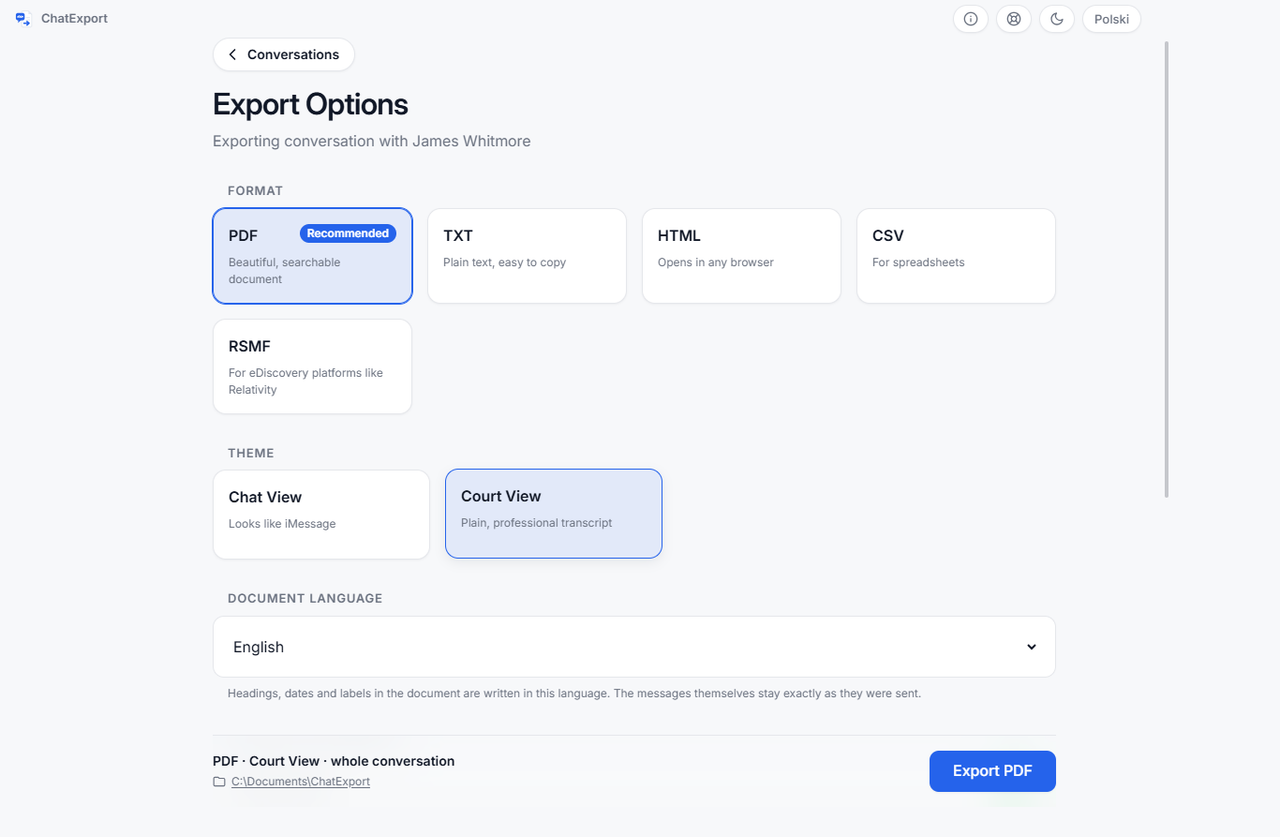
Two things on that screen decide the document, and only one of them is the range. Pick Court View as the theme. Choosing it is what switches on the full timestamps, the sender numbers, the message numbering and the receipts that the next section lists; leave it on Chat View, which is the default, and you get the version that looks like a phone and carries none of them.
Then note what the summary line at the bottom of that screen says before you touch anything: whole conversation. That is the default, it is the right default for a court, and in a grievance it is the setting you should make a decision about rather than inherit. The date range sits further down the same screen.
One limitation belongs here rather than in a footnote, because it decides how much thought the range deserves. You cannot black out lines in the finished document. ChatExport exports what is inside the range you chose, and there is no redaction tool: blacking out content before the file is hashed is on the roadmap and is not in any release you can download today. So the range is the only control you have over what a colleague reads, which is the argument for choosing it deliberately instead of accepting the default and hoping.
What does the panel see on the page?
The same things a court would look for, doing the same work for a different reader. None of it is decoration, and each line closes a question somebody would otherwise ask in a meeting.
| On the page | What it settles |
|---|---|
| A full timestamp on every message, with the time zone | The order of events, which is usually the whole argument in a grievance about conduct |
| The sender’s number beside the name | That these came from a phone rather than from your memory of it. A name is a label from your address book |
| A number on every message | That a meeting can refer to “message 47” instead of passing a laptop around |
| Title page: participants, message count, date range, time zone | What the document contains, stated before anyone reads a word of it, including the range you chose |
| Delivery and read receipts, where iOS recorded them | Whether something arrived, which is a different claim from whether it was sent. An absent read receipt proves nothing, since the other person may simply have them switched off |
| An attachment index, which is a separate switch under More options | What was sent alongside the words, and what is missing |
| A SHA256 of the finished file | That the file has not changed since you exported it. Write it down with the date on the day you make it |
Screenshots carry almost none of that. They are also, in a workplace context, the format everyone sends, which is why a transcript stands out: someone reading a folder of cropped images has to take on trust everything a dated transcript would have shown them.
What can this not do?
It cannot make anyone believe you, and it cannot substitute for the parts of the process that are not about documents.
- It cannot prove who was holding the phone. It reproduces what is in the backup. Who typed a message is a separate question, answered by other things.
- It cannot reach messages deleted long before the backup was made. iOS 16 and later hold deleted messages in a Recently Deleted store for roughly thirty days, so a backup made inside that window still contains them and the export has a switch that includes them. Past that window a backup is a copy of one moment, and an older backup made before the deletion is the only route.
- It cannot decide what you are allowed to disclose. Whether a private conversation can be put into a workplace process, and what happens to the other participants’ personal data when you do, is a question for a union representative or a lawyer, not for software.
- It cannot hide anything inside the range you picked. See the redaction note above.
- It cannot make an outcome go your way. It removes the argument about whether the messages say what you say they say, which is a smaller and more useful claim.
Frequently asked questions
Can my employer require me to hand over messages from my personal phone?
That is a question about your contract, your jurisdiction and the procedure being run, and it is worth asking a union representative or a lawyer before you answer it yourself. This article covers what the document should look like once you have decided to produce one.
Should I just send screenshots?
You can, and most people do, which is the argument against it. A screenshot carries the time iOS happened to display, no sender number, no indication of what sat above or below the frame, and nothing showing the image has not been edited. In a process where someone is deciding what to believe, all four of those are questions you have handed to the other side for free.
Can I remove the messages I would rather the panel did not read?
Not from the document. There is no redaction in any released version, so anything inside the date range you choose appears in the export. The range is the decision, and it is the reason to make it carefully rather than to export a whole year by default.
Does the person I complained about get to see what I submitted?
Usually, in some form, whatever the country: a procedure that decides against someone without telling them the case against them is unfair on its face. Exactly what is shared and when is a question for whoever is running the process, and asking it in advance is reasonable and normal.
What if the conversation is on WhatsApp rather than in Messages?
Use WhatsApp’s own “Export chat” from inside the conversation and import the file it produces. That route works from an Android phone as well, and it does not need a phone backup at all. The resulting document is the same one described above.
Do I need the phone the whole time?
Only for the backup. Plug it in, back it up to the PC with Apple’s own software, and after that the phone can go back in your pocket. Everything else happens on the computer.
What does the software cost?
The download is a free trial: it exports every format and reads encrypted backups, but the pages carry a watermark and each document stops at the 50 most recent messages in a conversation. A one time licence lifts both limits and is on sale now. There will never be a subscription.
The mechanics in full, including making the backup and what the finished document looks like page by page, are in how to print text messages from an iPhone for court. If the cost is the constraint rather than the method, how to print text messages for court free does the arithmetic on the free routes, and it applies to a grievance unchanged: the free version of this job is still three hours of screenshotting.